Temperature: Why the Same Question Gets Different AI Answers
Ask an AI system the same question twice and you can get two different answers. It is not a bug or a glitch: it is a design choice, controlled by a parameter called temperature. Temperature sets how much freedom the model gives itself when picking the next word: low, and answers become predictable and repeatable; high, and they become varied and creative but less stable. Understanding this parameter suddenly explains a lot of things that seem strange: why a model sometimes makes things up, why two tries do not match, why the same request works better one moment and worse the next. This is not a detail for engineers: it is the reason you cannot judge an AI system on a single answer, and why comparing multiple perspectives matters more than one lucky attempt.
by Redazione AI Arena
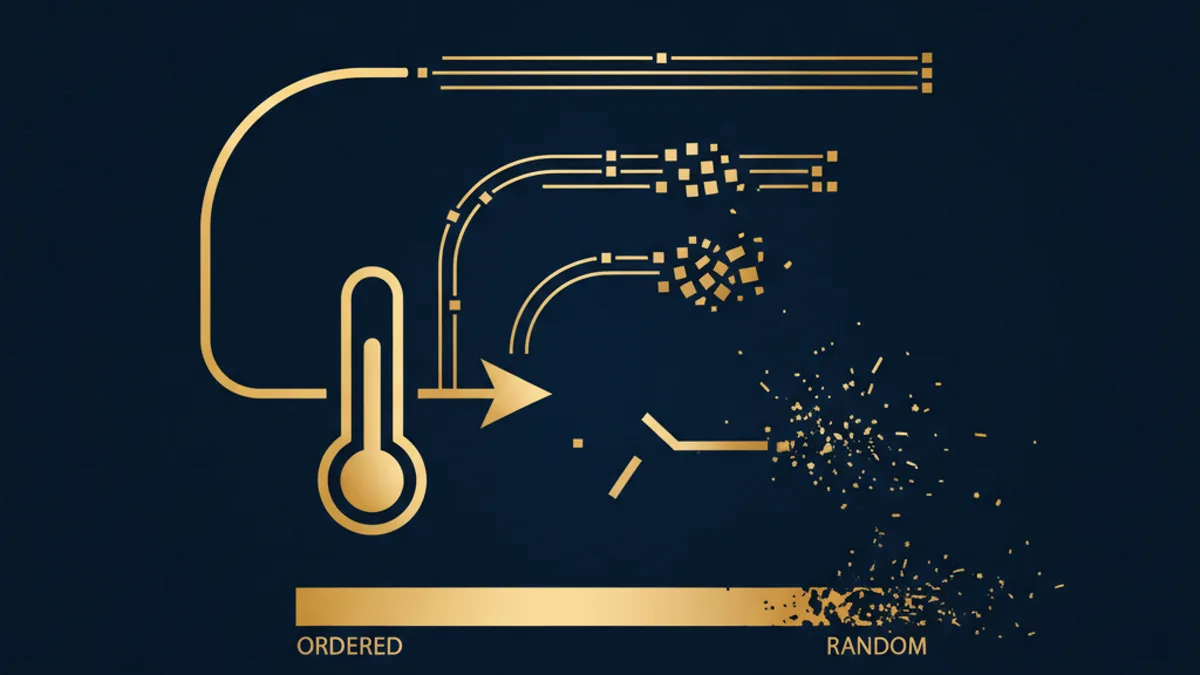
Ask an AI system the same question, then repeat it word for word a few minutes later. You may get two different answers: different in wording, sometimes even in content. The first reaction is to think of a bug, or an unreliable system. It is not. That variability is a design choice, governed by a parameter with a precise name: temperature. Grasping it suddenly explains a lot of things that seem strange, and it changes how you judge any AI answer.
How a model picks the next word
An AI model writes one word at a time. At each step it does not face a single mandatory word, but a spread of candidates, each with a probability: after "the coffee is" the word "hot" is very likely, "green" much less so, but neither is impossible. The way the model chooses within that spread is not rigid: it does not always take the most probable candidate. It samples, meaning it draws from that distribution with a margin of controlled randomness.
Temperature is exactly the dial that controls that margin. With low temperature the model squeezes the probabilities toward the best candidate: it almost always picks the most predictable word, and answers become stable, repeatable, nearly identical every time. With high temperature it flattens the differences and gives more room to less likely candidates too: answers become more varied, more surprising, sometimes more creative, but also less predictable. There is nothing magic about it; it is a trade-off between two opposing needs.
Why two answers do not match
From here it is easy to see why the same question can produce different answers. As long as temperature stays above zero, every run keeps that pinch of randomness: the model only needs to pick a different word in the opening beats for the whole answer to take another path and end up far from the previous one. It is not a sign that the model "got it wrong" one of the two times: they are two paths, both legitimate, within the same spread of possibilities.
Only by pushing temperature to the minimum does behavior become almost deterministic, meaning the model tends to return the same answer every time. But even there the word "almost" matters: perfect repeatability is more of a technical exception than the everyday norm. That is why judging an AI system on a single answer is misleading. That answer is one sample, one of many the system could have generated. A brilliant attempt does not prove the model is always this good; a weak one does not prove it is always this poor. You are looking at a single frame, not the whole film.
Not a flaw, a trade-off to manage
The question "is low or high temperature better" has no single answer, because it depends on the task. When you need precision and repeatability — extracting data, following strict instructions, answering a question with a well-defined solution — low temperature is preferable: imagination, there, is a risk more than an asset. When instead you need variety — generating ideas, exploring different phrasings, looking for new angles on an open problem — a higher temperature helps, because getting the same answer every time would be limiting. Raise the temperature and you gain creativity but lose stability; lower it and you gain consistency but lose richness. It is the kind of hidden trade-off that runs through every AI system, not a quirk of one model or another.
The problem, if anything, is not variability itself: it is invisible variability. If you do not know an answer is only one of many possible, you risk taking it as final. Variability becomes an asset the exact moment you make it explicit, that is, when you stop settling for the first attempt and put several answers side by side. At that point the same variety that looked like noise turns into information: it shows you where the model is firm — because it keeps landing on the same conclusions — and where it wobbles, and therefore where it is worth thinking things through before deciding.
Where the AI world is heading
The direction is clear: not a single model queried just once, but systems that know how to use multiple voices and read their variety as a signal. Detached, disconnected conversations, where you open several tabs and compare by hand answers that do not talk to each other, miss this: each window lives on its own and variety stays an annoyance to manage, not information to exploit. The useful revolution is not having a model that "nails" the answer on the first try, but a flow that compares multiple complementary perspectives on the same problem and shows you where they converge and where they do not.
AI Arena is the platform that puts multiple AI identities with different perspectives side by side on the same problem, lets you select the most useful answers, and uses an Orchestrator to take you to the next step; it does not replace your decision, it helps you make it with more awareness. You pick the team, 7 complementary specialists each write their own version, you select what really holds up, and the meta-layer carries the flow through to the final report. Response variability, instead of staying a hidden risk behind a single attempt, becomes a readable map: you see where the AI is stable and where it wobbles, and you decide knowing what you are standing on.
Join Arena.
FAQ
What is temperature in an AI model?
Temperature is a parameter that controls how much freedom an AI model gives itself when picking the next word as it writes an answer. At each step the model does not have a single possible word, but a list of candidates, each with its own probability. Temperature decides how much weight to give those probabilities: with low temperature the model almost always takes the most probable candidate, so answers become predictable and repeatable; with high temperature it gives more room to less likely candidates too, so answers become more varied, surprising, and sometimes more creative. It is not a flaw or a mysterious dial, but a design choice that balances stability against variety depending on what you need.
Why does the same question produce different answers?
Because most AI systems do not pick the next word rigidly, but sample it from a probability distribution. If temperature is above zero, a margin of randomness remains: two runs of the same request can take different paths from the very first words and end in answers that are far apart. It is not an error or a sign that the model got it wrong: it is the expected behavior of a system built to be flexible. Only by lowering temperature to the minimum does the model behave almost deterministically, giving nearly the same answer every time. That is why a single attempt never describes on its own what a model can really do.
Is low or high temperature better?
It depends on the task; there is no universally right value. Low temperature is preferable when precision and repeatability matter: extracting data, following strict instructions, answering questions with a well-defined solution, where imagination is a risk more than an asset. High temperature helps when you need variety: generating ideas, exploring different phrasings, looking for new angles on an open problem, where getting the same answer every time would be limiting. The point is that raising temperature gains creativity but loses stability, and lowering it gains consistency but loses richness. It is not about picking the best, but about knowing which trade-off you need in that moment.
Is AI variability a problem?
Not in itself: it is only a problem when it stays invisible. If you judge an AI system on a single answer, you are looking at one sample of a process that could have produced many others, and you risk mistaking a lucky attempt for the rule or a weak one for a limit of the model. The real risk is not variety itself, but not knowing it is there: taking as final an answer that was only one of many possible. Variability becomes an asset the moment you make it explicit, that is, when you compare multiple answers instead of stopping at the first. Then the same variety that looked like noise turns into information: it shows you where the model is stable and where it wobbles.
How does AI Arena help with response variability?
AI Arena is the platform that puts multiple AI identities with different perspectives side by side on the same problem, lets you select the most useful answers, and uses an Orchestrator to take you to the next step; it does not replace your decision, it helps you make it with more awareness. Faced with variability this changes everything: instead of relying on a single attempt, which by nature is only one of many possible, you see multiple complementary perspectives lined up on the same problem. Where they converge, you have a strong signal of solidity; where they diverge, you immediately see the points where the answer is less stable and worth thinking through before deciding. You pick the team, 7 complementary specialists each write their own version, you select what holds up, and the meta-layer carries the flow through to the final report. Variety stops being a hidden risk and becomes a map you can trust.
Topics